
 Image 1 of 1
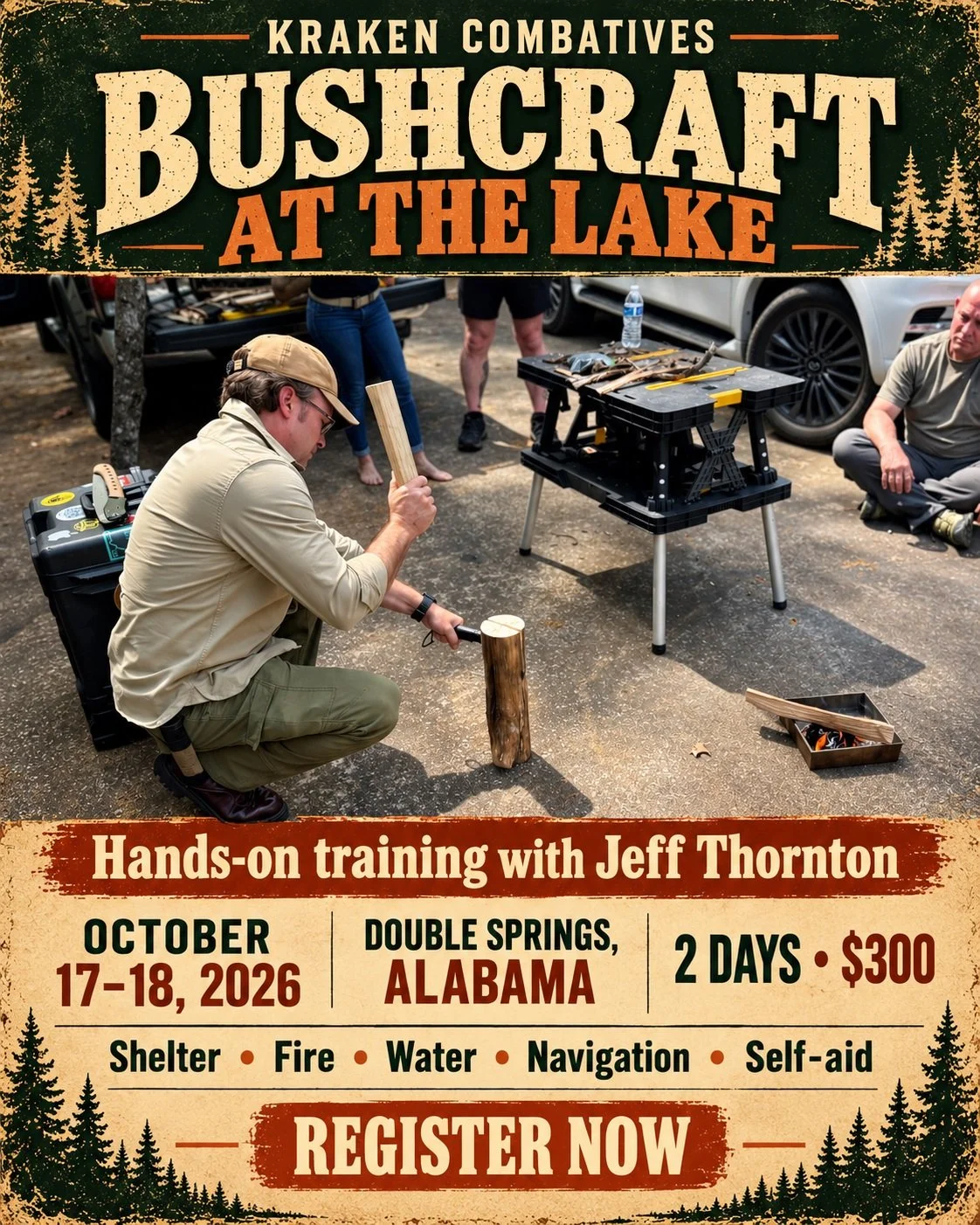
Bushcraft at the Lake
Master the Wild: Core Lessons in Wilderness Survival & Bushcraft
When you step into the backcountry, you leave behind the safety nets of modern infrastructure. If you travel into the wilderness without training, you are entirely at the mercy of Mother Nature. This briefing, led by survival expert Jeff Thornton, distills decades of practical experience into an essential roadmap for self-aid, environmental adaptation, and primitive wilderness living.
INSTRUCTOR
Jeff Thornton
• Retired Coast Guard
• Search & Rescue / Survival Expert
• Combatives University Grey Belt
•Karate Black Belts
[9/14/2026 11:43 AM] Jeff Thornton: Here is the course description. Warning: it’s a lot of words!
Master the Wild: Core Lessons in Wilderness Survival & Bushcraft
When you step into the backcountry, you leave behind the safety nets of modern infrastructure. If you travel into the wilderness without training, you are entirely at the mercy of Mother Nature. This briefing, led by survival expert Jeff Thornton, distills decades of practical experience into an essential roadmap for self-aid, environmental adaptation, and primitive wilderness living.
Below are the foundational pillars and lessons captured in this training:
1. The Philosophy: Skills Over Gear
In the beginning, outdoor enthusiasts rely heavily on gear to sustain themselves because they lack the skills to need less. True survival education is about shifting this balance. Knowledge occupies no space and weighs nothing. By training your mind and hands, you replace heavy physical dependency on equipment with high-yield bushcraft skills, transforming dead weight into field-expedient resourcefulness.
2. The Core Priority: Core Temperature Management (CTM)
Survival is simple, but not easy. Your absolute highest priority is maintaining your core body temperature and keeping your blood inside your body. Utilizing the Rule of 3s, you will learn how exposure can claim a life in just 3 hours without shelter. Through the thermodynamic heat loss formula——this brief teaches you how to optimize ground insulation (-value) and leverage shelter construction ("something to sleep on, in, and under") to prevent conductive and convective heat loss.
3. The 5 Cs of Survival & Sustainability
Every item in your pack must be multi-functional. The course introduces the industry-standard 5 Cs of Survival:
• Cutting Tools: The utility of full-tang knives and saws.
• Cover: Setting up fast-deployment ridgelines and maximizing compressed ground loft.
• Combustion: Mastering heat and signaling.
• Containers: Collecting, storing, and sterilizing water.
• Cordage: Utilizing versatile materials like bankline and paracord.
Additionally, you will explore the 5 Cs of Sustainability (Cotton, Cargo Tape, Compass, Candling, and Canvas Needles) to maintain your gear and navigate effectively.
4. Fire & Clean Water Mastery
Mastering the conjuration of fire is a vital, life-saving skill. Understanding how to make fire using primitive skills to make fire is a significant sustainability skillset to use when modern tools are unabailable. This brief breaks down the mechanics of friction-based heat, guiding you through primitive methods like the Bow Drill, Hand Drill, and Fire Plough.
Fire is vital to to answering your bodies hydration needs with safe potable water. You will learn the science of diagnosing and treating water contaminants, using initial filtration tools like Milbank bags to remove turbidity before applying chemical, physical, or boiling disinfection methods.
5. Mindset: The "STOP" Protocol & Silent Awareness
Your brain is your ultimate survival tool. When lost or facing emergency conditions, you must deploy the STOP framework: Stop (sit down, rest, maintain a positive attitude), Think, Observe, and Plan. True psychological endurance relies on evaluating actual threats rather than perceived fears, managing your physical energy deliberately, and moving through contested or wild environments with quiet, adaptive mobility.
Master the Wild: Hands-On Wilderness Survival & Bushcraft Course
When you step into the backcountry, you leave behind the safety nets of modern infrastructure. Going off-grid without practical training means you are entirely at the mercy of the elements. Led by survival expert Jeff Thornton, this intensive, hands-on course is designed to transition you from gear-reliance to self-sufficiency.
Through practical field application, students will learn to administer self-aid, manage core body temperature, navigate challenging terrain, and secure clean resources using the landscape itself.
Course Curriculum & Training Modules
Module 1: Self-Aid & The 5 Bs of Survivability
[9/14/2026 11:43 AM] Jeff Thornton: True survival starts with maintaining your internal systems under pressure. Students will learn how to maintain total situational awareness—both internal and external—and implement the 5 Ds of Survival (Don't panic, Don't bleed out, Don't get dehydrated, Don't get too hot, Don't get too cold).
You will receive direct, hands-on training to address the 5 Bs of Survivability to successfully navigate a 72-hour emergency event:
• Bleeding: Immediate application of direct pressure, wound-packing gauze, and tactical tourniquets.
• Breaks: Crafting field-expedient splints using natural materials (branches) and standard gear (tent stakes, sleeping mats).
• Burns: Sterile irrigation techniques using cool, clean water to prevent critical pathogens and infections, followed by proper dressing.
• Blisters: Foot care management using dry white wood ash as a natural drying powder, popping friction points safely, and applying protective cargo tape.
• Bites & Stings: Safe extraction of stingers/ticks using multi-tools and sourcing native, wild medicinal plants for localized pain relief.
Module 2: Core Temperature Management & Shelter Crafting
Your physical priority in any weather is managing your core temperature to prevent hypothermia. Students will learn the thermodynamics of heat loss () and how to construct a complete, protective microclimate consisting of three distinct layers:
1. Something to Sleep ON: Calculating ground insulation R-values. You will learn to construct a dry "browse bed" using leaf litter, pine straw, and heavy-duty trash bags to achieve the critical 3 inches of compacted loft needed to stop conductive ground heat loss.
2. Something to Sleep IN: Mastering environmental clothing layers (wicking, insulating, durable, and weather-proof) to trap body heat.
3. Something to Sleep UNDER: Rapid deployment of multi-configuration tarp shelters (Lean-to, Plow Point, A-frame) to block wind and rain.
10 Essential Knots for Wilderness Recreation
To build reliable, fast-deployment shelter systems and secure gear, students will physically practice and master these ten core knots:
• Marlin Spike
• Slip Knot
• Bowline
• Single Fisherman's
• Lark's Head
• Prusik
• Double Overhand
• Arbor Knot
• Sheet Bend
• Half Hitch
Module 3: The 5 Ws of Camp Selection
Setting up camp in the wrong spot can turn a minor survival situation into a disaster. Students will be trained to evaluate potential campsites dynamically based on the 5 Ws:
• Wood: Proximity to sustainable, dry fuel sources for warmth, water purification, and psychological comfort.
• Water: Balancing the need for hydration with safety. You will learn why camping too close to water sources increases tactical exposure and wildlife encounters.
• Weather: Finding natural windbreaks, identifying low-lying frost pockets, and avoiding potential flood zones.
• Widow Makers: Actively scanning overhead trees for hanging dead limbs or loose rocks before pitching shelter.
• Wildlife: Evaluating animal trails, avoiding insect nesting grounds (such as ant beds), and identifying local snake habitats.
Module 4: Water Sourcing, Collection, & Disinfection
Water is life, but unpurified water is a vector for illness. Students will learn to read the landscape to locate water indicators (such as willow, sycamore, and river birch trees) and collect water safely using dry bags, transpiration bags, and nesting cups.
You will be trained in the three-step water-cleansing process:
1. Coarse Filtration: Utilizing cotton cloths or specialized Milbank bags to remove heavy mud and turbidity, dramatically extending the life of your fine filters.
2. Chemical Treatment: Calculating proper dosing for emergency disinfectants (iodine, chlorine dioxide).
3. Physical Purification & Boiling: Sourcing water and bringing it to a true, rolling boil. Students will learn how altitude affects boiling points and how to properly adjust boiling times to destroy all bacteria, viruses, and protozoa.
Module 5: Modern & Primitive Land Navigation
A lost survivor is a vulnerable survivor.
[9/14/2026 11:43 AM] Jeff Thornton: This course teaches students how to systematically mitigate lateral drift and move with absolute direction.
Modern Navigation Tools
Using a compass, topographic maps, pace beads, and protractors, you will learn to walk straight lines and navigate by :
• Adjust for local magnetic declination.
• Estimate distance using personal pace counts calibrated across flat, uphill, and downhill terrains.
• Shoot and follow precise bearings while logging travel routes on weather-proof paper.
Primitive Wayfinding Methods
If your electronic devices fail and your compass is lost, you will learn to navigate using primitive methods:
• First Shadow / Last Shadow Method: Planting a central stick at dawn and dusk to draw a highly accurate East/West and North/South orientation line.
• Horizon Line Adjustment Method: Using hand-width measurements against the solar arc (where each finger width represents 15 minutes or 3.75 degrees of travel) to calculate the sun's position and orient yourself due North.
TO REGISTER use link Below
https://myfirearmsconcierge.corsizio.com/event/6a96ef65b4270dc2ebabd155
Master the Wild: Core Lessons in Wilderness Survival & Bushcraft
When you step into the backcountry, you leave behind the safety nets of modern infrastructure. If you travel into the wilderness without training, you are entirely at the mercy of Mother Nature. This briefing, led by survival expert Jeff Thornton, distills decades of practical experience into an essential roadmap for self-aid, environmental adaptation, and primitive wilderness living.
INSTRUCTOR
Jeff Thornton
• Retired Coast Guard
• Search & Rescue / Survival Expert
• Combatives University Grey Belt
•Karate Black Belts
[9/14/2026 11:43 AM] Jeff Thornton: Here is the course description. Warning: it’s a lot of words!
Master the Wild: Core Lessons in Wilderness Survival & Bushcraft
When you step into the backcountry, you leave behind the safety nets of modern infrastructure. If you travel into the wilderness without training, you are entirely at the mercy of Mother Nature. This briefing, led by survival expert Jeff Thornton, distills decades of practical experience into an essential roadmap for self-aid, environmental adaptation, and primitive wilderness living.
Below are the foundational pillars and lessons captured in this training:
1. The Philosophy: Skills Over Gear
In the beginning, outdoor enthusiasts rely heavily on gear to sustain themselves because they lack the skills to need less. True survival education is about shifting this balance. Knowledge occupies no space and weighs nothing. By training your mind and hands, you replace heavy physical dependency on equipment with high-yield bushcraft skills, transforming dead weight into field-expedient resourcefulness.
2. The Core Priority: Core Temperature Management (CTM)
Survival is simple, but not easy. Your absolute highest priority is maintaining your core body temperature and keeping your blood inside your body. Utilizing the Rule of 3s, you will learn how exposure can claim a life in just 3 hours without shelter. Through the thermodynamic heat loss formula——this brief teaches you how to optimize ground insulation (-value) and leverage shelter construction ("something to sleep on, in, and under") to prevent conductive and convective heat loss.
3. The 5 Cs of Survival & Sustainability
Every item in your pack must be multi-functional. The course introduces the industry-standard 5 Cs of Survival:
• Cutting Tools: The utility of full-tang knives and saws.
• Cover: Setting up fast-deployment ridgelines and maximizing compressed ground loft.
• Combustion: Mastering heat and signaling.
• Containers: Collecting, storing, and sterilizing water.
• Cordage: Utilizing versatile materials like bankline and paracord.
Additionally, you will explore the 5 Cs of Sustainability (Cotton, Cargo Tape, Compass, Candling, and Canvas Needles) to maintain your gear and navigate effectively.
4. Fire & Clean Water Mastery
Mastering the conjuration of fire is a vital, life-saving skill. Understanding how to make fire using primitive skills to make fire is a significant sustainability skillset to use when modern tools are unabailable. This brief breaks down the mechanics of friction-based heat, guiding you through primitive methods like the Bow Drill, Hand Drill, and Fire Plough.
Fire is vital to to answering your bodies hydration needs with safe potable water. You will learn the science of diagnosing and treating water contaminants, using initial filtration tools like Milbank bags to remove turbidity before applying chemical, physical, or boiling disinfection methods.
5. Mindset: The "STOP" Protocol & Silent Awareness
Your brain is your ultimate survival tool. When lost or facing emergency conditions, you must deploy the STOP framework: Stop (sit down, rest, maintain a positive attitude), Think, Observe, and Plan. True psychological endurance relies on evaluating actual threats rather than perceived fears, managing your physical energy deliberately, and moving through contested or wild environments with quiet, adaptive mobility.
Master the Wild: Hands-On Wilderness Survival & Bushcraft Course
When you step into the backcountry, you leave behind the safety nets of modern infrastructure. Going off-grid without practical training means you are entirely at the mercy of the elements. Led by survival expert Jeff Thornton, this intensive, hands-on course is designed to transition you from gear-reliance to self-sufficiency.
Through practical field application, students will learn to administer self-aid, manage core body temperature, navigate challenging terrain, and secure clean resources using the landscape itself.
Course Curriculum & Training Modules
Module 1: Self-Aid & The 5 Bs of Survivability
[9/14/2026 11:43 AM] Jeff Thornton: True survival starts with maintaining your internal systems under pressure. Students will learn how to maintain total situational awareness—both internal and external—and implement the 5 Ds of Survival (Don't panic, Don't bleed out, Don't get dehydrated, Don't get too hot, Don't get too cold).
You will receive direct, hands-on training to address the 5 Bs of Survivability to successfully navigate a 72-hour emergency event:
• Bleeding: Immediate application of direct pressure, wound-packing gauze, and tactical tourniquets.
• Breaks: Crafting field-expedient splints using natural materials (branches) and standard gear (tent stakes, sleeping mats).
• Burns: Sterile irrigation techniques using cool, clean water to prevent critical pathogens and infections, followed by proper dressing.
• Blisters: Foot care management using dry white wood ash as a natural drying powder, popping friction points safely, and applying protective cargo tape.
• Bites & Stings: Safe extraction of stingers/ticks using multi-tools and sourcing native, wild medicinal plants for localized pain relief.
Module 2: Core Temperature Management & Shelter Crafting
Your physical priority in any weather is managing your core temperature to prevent hypothermia. Students will learn the thermodynamics of heat loss () and how to construct a complete, protective microclimate consisting of three distinct layers:
1. Something to Sleep ON: Calculating ground insulation R-values. You will learn to construct a dry "browse bed" using leaf litter, pine straw, and heavy-duty trash bags to achieve the critical 3 inches of compacted loft needed to stop conductive ground heat loss.
2. Something to Sleep IN: Mastering environmental clothing layers (wicking, insulating, durable, and weather-proof) to trap body heat.
3. Something to Sleep UNDER: Rapid deployment of multi-configuration tarp shelters (Lean-to, Plow Point, A-frame) to block wind and rain.
10 Essential Knots for Wilderness Recreation
To build reliable, fast-deployment shelter systems and secure gear, students will physically practice and master these ten core knots:
• Marlin Spike
• Slip Knot
• Bowline
• Single Fisherman's
• Lark's Head
• Prusik
• Double Overhand
• Arbor Knot
• Sheet Bend
• Half Hitch
Module 3: The 5 Ws of Camp Selection
Setting up camp in the wrong spot can turn a minor survival situation into a disaster. Students will be trained to evaluate potential campsites dynamically based on the 5 Ws:
• Wood: Proximity to sustainable, dry fuel sources for warmth, water purification, and psychological comfort.
• Water: Balancing the need for hydration with safety. You will learn why camping too close to water sources increases tactical exposure and wildlife encounters.
• Weather: Finding natural windbreaks, identifying low-lying frost pockets, and avoiding potential flood zones.
• Widow Makers: Actively scanning overhead trees for hanging dead limbs or loose rocks before pitching shelter.
• Wildlife: Evaluating animal trails, avoiding insect nesting grounds (such as ant beds), and identifying local snake habitats.
Module 4: Water Sourcing, Collection, & Disinfection
Water is life, but unpurified water is a vector for illness. Students will learn to read the landscape to locate water indicators (such as willow, sycamore, and river birch trees) and collect water safely using dry bags, transpiration bags, and nesting cups.
You will be trained in the three-step water-cleansing process:
1. Coarse Filtration: Utilizing cotton cloths or specialized Milbank bags to remove heavy mud and turbidity, dramatically extending the life of your fine filters.
2. Chemical Treatment: Calculating proper dosing for emergency disinfectants (iodine, chlorine dioxide).
3. Physical Purification & Boiling: Sourcing water and bringing it to a true, rolling boil. Students will learn how altitude affects boiling points and how to properly adjust boiling times to destroy all bacteria, viruses, and protozoa.
Module 5: Modern & Primitive Land Navigation
A lost survivor is a vulnerable survivor.
[9/14/2026 11:43 AM] Jeff Thornton: This course teaches students how to systematically mitigate lateral drift and move with absolute direction.
Modern Navigation Tools
Using a compass, topographic maps, pace beads, and protractors, you will learn to walk straight lines and navigate by :
• Adjust for local magnetic declination.
• Estimate distance using personal pace counts calibrated across flat, uphill, and downhill terrains.
• Shoot and follow precise bearings while logging travel routes on weather-proof paper.
Primitive Wayfinding Methods
If your electronic devices fail and your compass is lost, you will learn to navigate using primitive methods:
• First Shadow / Last Shadow Method: Planting a central stick at dawn and dusk to draw a highly accurate East/West and North/South orientation line.
• Horizon Line Adjustment Method: Using hand-width measurements against the solar arc (where each finger width represents 15 minutes or 3.75 degrees of travel) to calculate the sun's position and orient yourself due North.
TO REGISTER use link Below
https://myfirearmsconcierge.corsizio.com/event/6a96ef65b4270dc2ebabd155